



If you’ve ever driven by or walked through a vineyard, you may have marvelled at the formality of the layout. Considerable planning has gone into how to produce the best grape yield per acre of land. Grape vines are grown row on row along an espaliered structure. Ideally, the rows run north and south to capture the most sunlight from the east/west exposure. The distance between the rows should equal the height of the vines. This ensures that there is no shading from one row to the next as well as no sunlight wasted on the vineyard floor.


My apple tree espalier runs along the west facing fence, and a pear tree is attached to lattice on the garage. The construction of both trainers is simple. I have eyebolts screwed into the fence and clothesline wire running through the bolts. This has been strong enough to hold the considerable weight of the apple tree branches. Given that the pear tree is much smaller, I’ve attached the branches to the lattice with twine.
Aside from the advantages of espalier already mentioned, it’s also an art form…a living sculpture. The pattern that you train your trees to grow is only limited by your imagination!
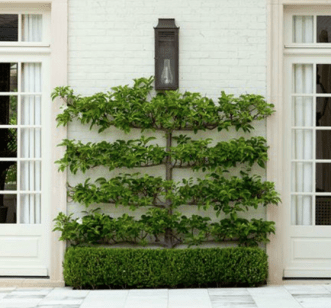


***It looks like the fence needs painting!


When I saw this picture, I wondered what espaliered trees would look like along one side of the back of my house. My back garden faces south, so the light exposure is perfect. There is a row of planters running the length of this wall, and when the flowers are all in bloom, it looks luscious, but during the rest of the year, it’s bland.
I did a rough sketch (an artist I’m not!) of what an espalier would look like and think it might be an interesting idea … but what about painting the house every five years or so… something to think about over the coming winter…


